2 sets of reaction conditions with iridium catalyst Ir(dF-CF3-ppy)2(dtbbpy)PF6, Ni/dtbbpy and 8 bases Cs2CO3, K3PO4, K2HPO4, KOH, Li2CO3, K2CO3, DABCO and DBU, 16 reaction vials total.
This kit requires EvoluChem™ PhotoRedOx Box – HCK 1006-01-016 and EvoluChem™ Light Source 18W-450 nm – HCK 1012-01-002 as well as Syringe, decapper and reaction block included in the EvoluChem Starter Kit (HCK1006-01-001)
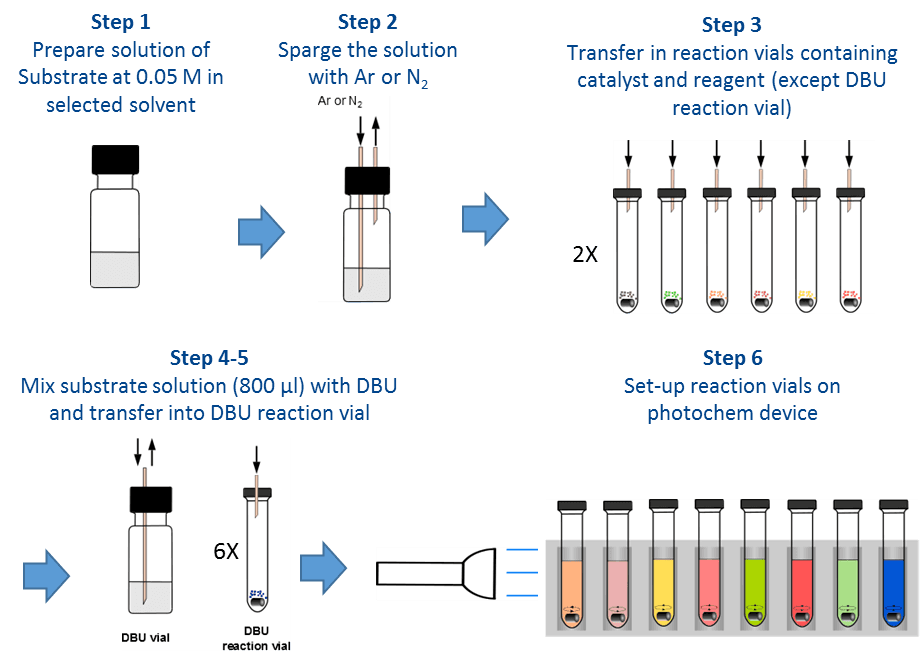
The typical protocol is performed at 0.05 mol/l using a solution containing two coupling components. Each sealed reaction vial contains 0.1 µmol of photocatalyst, 0.5 µmol Ni catalyst, 0.5 µmol ligand and 15 of µmol base (for all bases except for DBU conditions, base is added separately and shipped in a separate vial). The Ir/Ni photoredox kit contains 2 sets of vials allowing the screening of two different solvents. Sparging reaction solvents with nitrogen or argon while transferring reagents is important to achieve highest conversions of product. See protocol diagram for instructions. The vial holder shipped with the kit can be placed directly on the photochemistry device.
Protocol at 100 µl volume reaction condition
In the 4mL vial containing the quinuclidine, prepare 1.0 ml of substrate solution at 0.1 mol/L of bromide and excess alcohol (typically 3 equivalents, although less alcohol can be used). If different concentration is used, adjust volume accordingly. For example, 1.0 ml solution for 8 reaction conditions (extra to compensate potential evaporation). Acetonitrile is the recommended solvent, although acetone and ethyl acetate can be used.Degas substrate solution with subsurface sparging via N2 or Ar line with exit needle for 5 minutes.Using a clean and dry syringe, add 100 µl (or desired volume based on substrate concentration) of the substrate solution to each reaction vial.Repeat steps 2 and 3 for each substrate solvent mixture. Add full contents to remaining DBU reaction vial (4x).Repeat steps 2 and 5 for each substrate solvent mixture.Place samples in vial holder HCK-1006-01-017. Stir the reaction vials for 5 minutes prior to turning on the light to allow catalysts to fully dissolve (some bases will remain insoluble).Turn on lamp and stir vials for 12 to 24 hours (or longer if necessary). Be sure to plug in fan to maintain RT. Upon completion of reaction, remove the vial caps using a decapper.Prepare analytical sample for each reaction condition with 5 µl sample diluted into 200 µl in either DMSO or water/acetonitrile 50/50. Alternatively, reaction solvent can be evaporated in vacuo and crude mixture diluted in water/acetonitrile prior to preparation of analytical sample.Analyze resulting analytical samples by LC/MS.